Runtime Changes Everything. Here's Why We Built Around It.
Today is a big day. After two years of building, iterating, and partnering with the security leaders and teams we serve, Spektion is launching the complete Continuous Runtime Exposure Management Platform, now generally available right here at RSAC™ 2026 Conference. (Press release here.)
This is the platform we've been racing to build. Every capability in this latest release exists because a security leader somewhere needed it yesterday and didn’t have it. That changes today. I’m incredibly proud of all the new capabilities and the team that built it.
I want to take a minute to explain why this matters. This isn't just a product milestone. It's a turning point for every security team that's ever stared down a list of 50,000 critical CVEs and wondered where to start, while quietly knowing that the scariest exposure probably isn't captured in that list at all.
I know that feeling. Because I've been that person.
Where This Came From
At JLL and TransUnion, we had endpoint scanners feeding an RBVM platform. We layered on exploit intel, commercial threat intel, the whole stack. And we still had thousands of “priority” vulnerabilities we couldn’t action.
So we did what every well-resourced security team does. We pulled in the Red Team to manually assess which vulnerabilities were actually exploitable in our environment. It worked. But it didn’t scale. We were sampling, not covering.
That’s why we built Spektion. To provide continuous and comprehensive visibility into what’s exploitable based on evidence, not models or sample data.
If you’ve run a security program at scale, you know exactly what I’m describing. That’s who we built this for.
Runtime Security Is the Answer to the Observation Problem
Research has confirmed what most of us already suspected: CVSS-based prioritization is statistically equivalent to random selection. The problem was never a lack of data. It was a lack of observation. Tools can tell you what's vulnerable globally. None of them could tell you what's exploitable in your environment. What’s more, CVSS-scored vulnerabilities are a diminishing share of your total exploitable vulnerabilities.
That's the gap Spektion was built to close.
When we came out of stealth, runtime visibility for running software changed the game for our customers. They immediately asked, "Can you do this for CVEs too?" Today, the answer is yes. CVEs and every non-CVE exposure—secrets on disk, embedded components, browser extensions, AI workloads—finally together in one platform, assessed through the same runtime lens. Nothing theoretical. All of it observed.
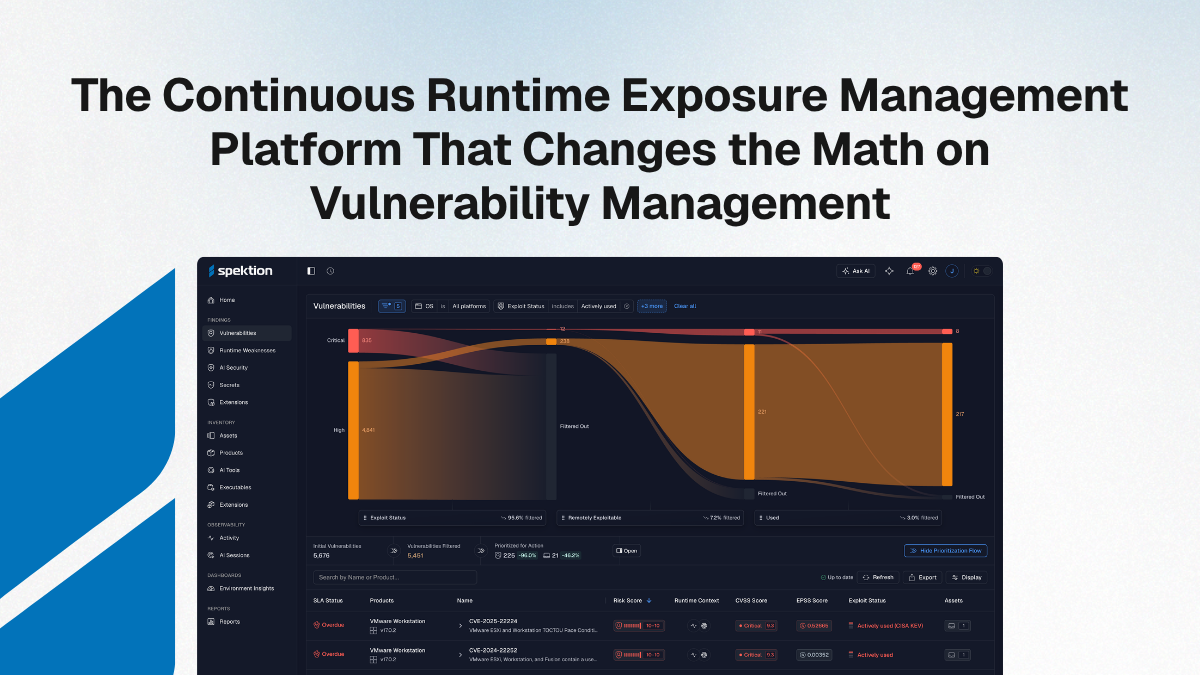
Our platform observes runtime execution data across every endpoint; not just what’s installed, but what’s actually running, at what privilege level, with what network exposure, with what blast radius. We combine six categories of runtime execution data to rank vulnerabilities based on real-world exploitability conditions specific to your environment.
The result: your scanner gives you 5,000 criticals. Spektion shows you the 200 that are genuinely exploitable, plus exploitable weaknesses in custom and internal applications that have zero CVE coverage and would never appear on any scanner’s radar.
Full Visibility: AI Agents and Workloads on Your Endpoints
Here’s the part of this launch I feel most proud of.
AI agents, MCP servers, coding assistants, and AI-generated executables are running on user endpoints right now—today—in nearly every enterprise environment. They are executing with real permissions, real network access, and real blast radius. And no traditional scanner, no EDR, no SBOM tool can see them.
Spektion inventories and assesses AI agent workloads as part of our standard runtime security visibility. We surface what’s running, what it’s doing, and what exposure it creates, before an attacker finds it first. This is visibility that the industry didn’t have a name for two years ago. It’s table stakes now.
From Signature-Based to Behavioral: We’ve Seen This Movie Before
The industry made a version of this move before—from antivirus to EDR. Antivirus matched signatures. EDR watched behavior. That shift didn’t just make detection better; it changed what detection meant.
We’re making the same move for runtime exposure management. From static severity scores assigned by external databases, to continuous runtime observation tied to your specific environment. From probabilistic risk models based on outdated intelligence to evidence-supported exploitability assessment. From “here’s what’s been exploited globally” to “here’s what’s exploitable in your environment, right now.”
That’s not an upgrade. That’s a different category.
To the Team, and To Everyone We Built This For
To our customers who partnered with us and everyone at Spektion who shipped this: thank you. This is the milestone we've been building toward, and we're only getting started.
To the CISOs and security leaders reading this: we built this for you. Security teams who are drowning in findings and prioritization workflows but can't get traction on real exposure reduction. Practitioners who know the scanner numbers are mostly noise but can't prove it to leadership. Leaders who need to show defensible progress, not just activity.
We’re at RSAC 2026, Booth ESE-07, this week. Come see what we built. Tell us what you’re dealing with. We’d rather earn your confidence than sell you on it.
And if you can’t make it to the floor: spektion.com
The CVE count goes up every year. Exposure outside of CVEs goes up faster. Exploit timelines go down. The window keeps shrinking.
Runtime is how you close it.