Stop Chasing. Start Fixing What Matters.
Know which vulnerabilities are actually exploitable before you send another patch list to IT.
Your scanner found 40,000 "critical" CVEs. Your RBVM product narrowed it to 4,000. You still can't say which ones are actually exploitable in your environment. Spektion observes software as it runs, so you can cut your patch list to precisely the ones that matter.

CVEs published in 2025
Up 20% year over year. Your scanner found all of them. None of it tells you what's actually exploitable in your environment.
Median time to patch 50% of critical vulns
Half of your critical vulnerabilities are still open after two months. Attackers stopped waiting weeks ago.
Time-to-exploit
Attackers are exploiting vulnerabilities before patches exist. Your patch cycle is already too late.
CVSS-based prioritization
CVSS-based prioritization is statistically equivalent to choosing vulnerabilities at random. You've been given bad math and told it's a strategy.
Your existing tools are answering the wrong question.
Scanners, RBVM, and threat intel all work from external data. They tell you what's exploited globally, what actors are active, and what EPSS predicts. None of it tells you whether a vulnerability is actually exploitable in your environment: is the software running, what privileges does it have, can an attacker reach it?


1. Your prioritization isn’t defensible
CVSS scores, EPSS probability, threat actor intel—none of it answers the question IT actually asks: "Does this even run on our machines?"
2. IT Ops is ignoring your reports
When you can't explain why CVE #3,847 matters more than #3,848 in your environment, the remediation team stops trusting the list.
3. Threat intel enrichment is only external data
Exploits don't give you the days that triage assumes.
4. The board asks if you're secure—you report patch counts
Patch velocity isn't provable risk reduction. You know it. They're starting to suspect it. You need a different answer.
Runtime context makes vulnerability prioritization possible.
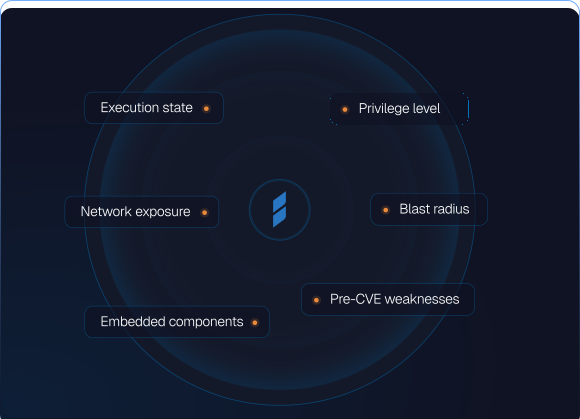
Spektion's lightweight sensor observes what's executing: what software is running, with what privileges, what's network-exposed, and other intelligent runtime signals. That runtime evidence is what your prioritization has been missing.
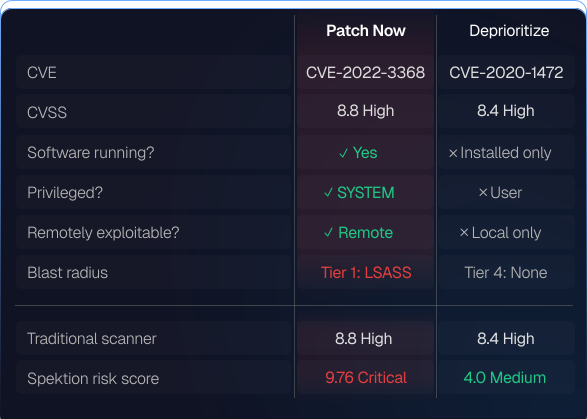
Prioritization—Same CVE. Only Spektion tells you if it matters.
Your current tools ask whether a CVE is dangerous in the world. Spektion asks whether it's exploitable here—on this endpoint, right now. Knowing which threat actors are exploiting a CVE globally doesn't tell you if the vulnerable software is even running on your machines. Runtime observation does.
Runtime Signals—Signals that turn "I think" into "I know."
When IT pushes back on your list, they're not being difficult—they're being rational. "Why this one?" is a fair question. Spektion gives you a fair answer, grounded in observed runtime reality, not probabilistic modeling.
For every vulnerability in your environment, Spektion reports: Is it executing? What privilege level? Can an attacker reach it? What can it reach if it is compromised? That's a list IT will act on.
Identification: know which criticals require action, with the evidence attached.
Some critical and high CVEs are noise, and without runtime context you cannot identify which ones require action. 50 to 80% of critical CVEs turn out not to require action.
The ones that remain are genuinely actionable—software that's running, network-exposed, and exploitable in your environment today. When IT asks, "Why this first?" you have an answer with evidence behind it.

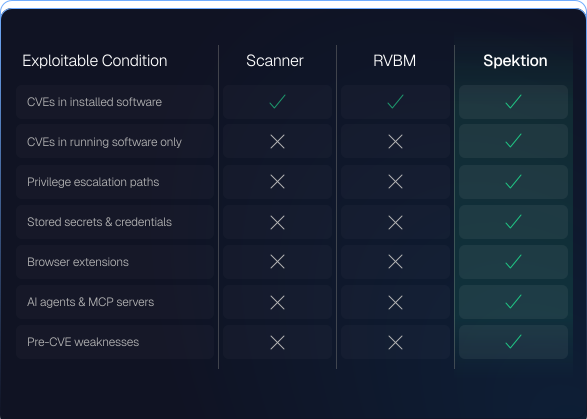
Beyond CVEs—CVE-based tools have a CVE-shaped hole.
Not every exploitable condition has a CVE. Secrets stored on disk. Browser extensions with excessive permissions. Embedded components inside applications. AI agents and MCP servers running without governance.
No CVE number. No scanner coverage. Absolutely exploitable. Spektion's sensor sees exploitable conditions regardless of whether a CVE exists, because it observes behavior, not just package manifests.
"We had Tenable, we had Vulcan, we had every threat intel feed money could buy. We were still pushing thousands of critical CVEs to IT that nobody could action. Spektion showed us what was actually running. It changed the entire conversation with our ops teams.
of critical CVEs turn out not to require action
Each one deprioritized with the runtime evidence that justifies it.
To first runtime
insights after deploy
First runtime evidence arrives within minutes of deploying the sensor.
fewer emergency patches
One customer, after deciding in minutes whether a headline CVE was exploitable in their environment.
From sensor deployment to defensible prioritization in days.
The Spektion sensor observes runtime behavior continuously. No sampling, no scheduling, no guessing. What's actually running, with what privileges, network-exposed, updated in real time across every endpoint.
Step 1
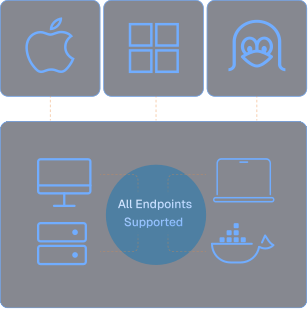
Deploy on Windows, Linux, and macOS through Intune, SCCM, Ansible, JAMF, Tanium, or CrowdStrike RTR. No reboot. First runtime evidence within minutes.
Step 2
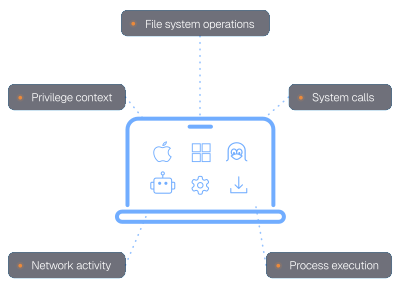
The sensor continuously monitors process execution, system calls, network activity, privilege context, and file system operations. Not what's installed; what's actually executing and how.
Step 3
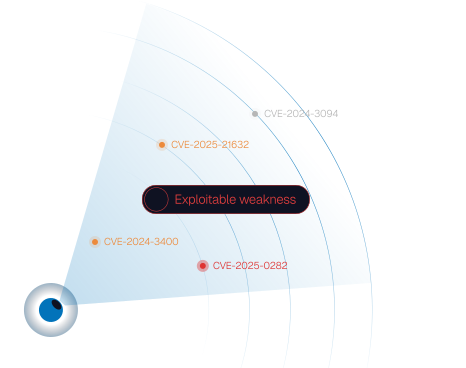
Spektion correlates runtime signals with CVEs and undisclosed vulnerabilities to produce exploitability verdicts. Every finding includes a full evidence log that is reviewable, auditable, and defensible.
Step 4
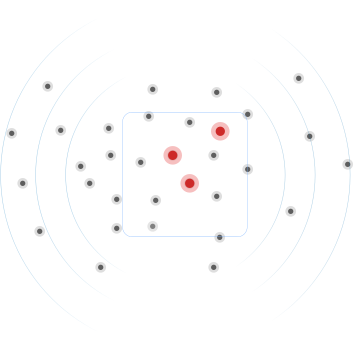
A prioritized list of the vulnerabilities that require action, each backed by runtime evidence. Feed it to your SIEM, SOAR, or ticketing via API. IT gets context. Security gets credibility.
Frequently asked questions about Spektion’s vulnerability prioritization.
If you're in a bake-off or building the business case, these are the answers you'll need.
Spektion combines asset criticality, exploit intel, and evidence of exploitability on your assets to provide a three-dimensional view of what matters. CVSS and threat intel tell you what's risky globally, not what's exploitable in your environment right now. Spektion observes software as it runs, its privileges, and whether it's network-accessible. With Spektion, your patch order reflects actual exploitability backed by runtime evidence, not a probability model. See how the two approaches compare in patch management vs vulnerability management.
Exploitation requires three things: vulnerable code must execute, attacker input must reach it, and compensating controls must be absent. Scanners tell you what's installed. They can't tell you whether any of those conditions are met. Runtime context adds exactly that: observed execution state, privilege level, and network exposure for every endpoint, continuously. The result is the difference between a theoretical vulnerability list and one you can actually act on.
Learn how runtime behavior reveals real-time exploit risk →Because they're built on external data based on known attacks only: global threat intel, exploit databases, and EPSS scores. They model what is known to have been exploited in other environments. They can't observe what's exploitable in your environment. If the input is incomplete, the prioritization will be too. Spektion changes the input entirely by adding runtime context into the picture that legacy tools have never had access to.
CVSS scores a vulnerability in isolation—severity, attack vector, complexity. Runtime exploitability asks a different question: is this software actually running, with what privileges, and is it reachable? The same CVE scores identically on every endpoint. Runtime observation resolves it differently based on what's actually happening. It tells you what medium-severity vulnerabilities are easily exploitable and what critical-severity vulnerabilities can safely be deprioritized. That's the gap Spektion closes.
Spektion can, but most can't because CVE-based tools have a CVE-shaped hole. They can only flag what's been catalogued by a scanner using the CVE database. Spektion detects exploitable conditions based on observed behavior: credentials stored on disk, browser extensions with excessive permissions, embedded components inside applications, privilege escalation paths, regardless of whether a CVE exists.
Spektion can replace an existing endpoint VM solution across every operating system, or sit alongside one to deliver the runtime evidence on exploitability that a CTEM program needs to work. Spektion's sensor covers what your endpoint scanner was doing, CVE detection across your operating systems and installed software, and adds continuous runtime assessment for what has no CVE: internally built applications, AI agents, and AI-generated executables.
Both. Spektion can feed runtime context into your existing RBVM tool via API—execution state, privilege level, network exposure—so your current prioritization model works with better input. Or it can replace the RBVM layer entirely, since Spektion's runtime-based prioritization covers what RBVM tools were trying to approximate with external data. Most customers start with one motion and end up with the other. During your trial, you will see which makes more sense in your environment.
Yes, and this is one of the most common deployment patterns. If you've invested in building a prioritization model, Spektion becomes the runtime data layer that feeds it—the eyes your model has been missing. Runtime context is available via API and MCP, so your existing workflows and scoring logic can factor in execution state, privileges, network exposure, and more.
50 to 80% of critical CVEs turn out not to require action. Where you land in that range depends on your environment. Sign up for a Proof-of-Value (POV) trial and see your number. No commitment required, just data.
A typical trial runs three weeks across 50-500 endpoints. Week 1: Deploy, access first runtime data within minutes, begin seeing CVE exposure, runtime risk, and undisclosed vulnerabilities, all together, in your environment. Week 2: Review findings together and identify which criticals require action. Week 3: Validate results, quantify the reduction, and build the business case with real data from your real environment.