Platform

The Spektion Platform

Some critical and high CVEs are noise. Runtime evidence shows which ones require action.

Break free from the vulnerability grind

If you’re here, you’re probably already living it:

Too many vulnerabilities, not enough signal

CVE coverage gaps for software you rely on

Prioritization based on partial context

Backlogs that grow faster than they shrink

Enough struggling with the old VM model. Step into a better one. Runtime evidence gets you there.

Runtime evidence turns CVE noise into clear action

Observing software at runtime replaces static vulnerability findings with continuous execution evidence—what’s running, what’s exposed, and what’s truly exploitable. Instead of working from CVE lists and scan snapshots, you work from live execution evidence that separates real risk from theoretical findings.

That lets your team:

Focus on exploitable CVEs in your environment, not just vulnerable software
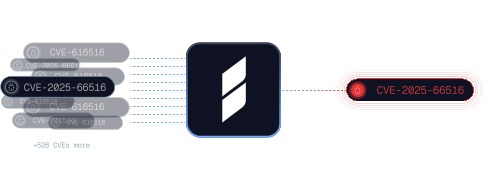
Surface undisclosed vulnerabilities that CVE databases never cover

Cut remediation cycles by focusing only on what's running and exposed
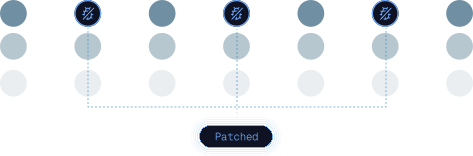
Apply targeted controls before patches are available

Four outcomes of runtime evidence: focus on exploitable CVEs, surface undisclosed vulnerabilities, shorten remediation, apply controls before a patch

How Spektion works

Is the software running? What privileges does it have? Is it network-exposed? What can it reach if it is compromised? Spektion answers the questions vulnerability scanners can't so you know what's actually exploitable in your environment and can act on it.

1. Observe software as it executes

Spektion’s lightweight sensor captures runtime evidence from your assets (Windows, macOS, Linux, and containers), including process behavior, privilege use, and network connections.

See what is truly running, not just what is installed.

2. Translate runtime signals into exposure insight

Spektion combines precise CVE detection with runtime evidence to provide clear exposure insights that highlight what’s truly risky in your environment and what isn’t.

Expose real exploitability, not just theoretical severity.

3. Prioritize what actually needs fixing

Runtime context separates urgent exposures from background noise, so teams can safely deprioritize non-exploitable findings and focus on what truly matters.

Turn long vulnerability lists into a small, defensible set of immediate priorities.

4. Show how to reduce the risk right now

For each exploitable condition, Spektion shows the preventive and detective controls your team can apply right away, from hardening settings to high-signal detections.

Move from exposure insight to active risk reduction in seconds, not ticket cycles.

Core capabilities for exploitability-driven defense

How runtime intelligence completes your CTEM program →

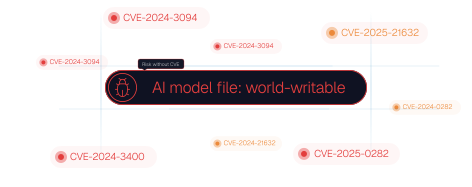
Identify which CVEs require action

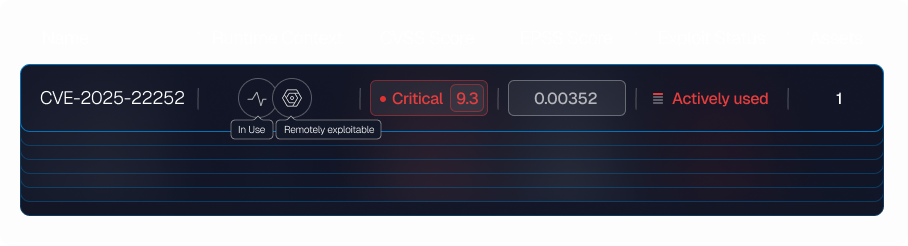
Prioritize CVE risk based on live environmental evidence, not generic severity or probability models.

Table row showing vulnerability CVE-2025-22252 with runtime context In Use and Remotely exploitable, CVSS score Critical 9.3, EPSS score 0.00352, exploit status Actively used, and 1 asset affected.

See what has no CVE

Assess and reduce risk across everything that executes, including internal applications, custom tools, AI-generated code, and vendor software without CVE coverage.

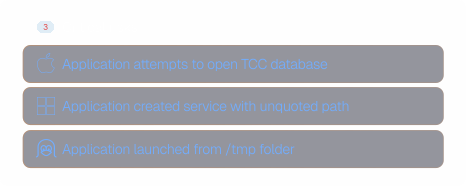
Find vulnerabilities before a CVE is published

Detect dangerous runtime conditions before formal disclosure, so you already understand your exposure when new vulnerabilities are announced.

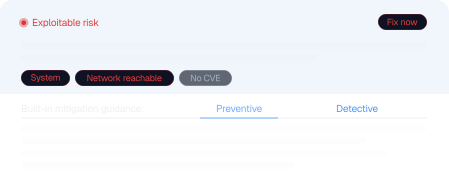
Act without a patch

Findings include guidance on applying compensating controls to accelerate remediation and response.

Better evidence in, better decisions out

Traditional exposure and vulnerability platforms still rely on scan results and vulnerability databases. Spektion is built on a runtime evidence layer that changes how you prioritize what to fix first—and why.

Traditional Vulnerability View

Periodic scan snapshots
What’s installed
CVE-only coverage
Severity & probability scores
Large remediation backlogs
Triage to validate

Runtime Evidence View

Continuous runtime observation
What’s actually executing
All running code and components
Observed exploitability evidence
Small, defensible priority set
Evidence is visible up front
As evidence improves, prioritization sharpens, and risk reduction follows.

What changes in real environments

With runtime evidence, VM programs shift quickly. Priority queues shrink, hidden exposure becomes visible, and teams spend far less time validating findings that never required action.

Reveal Inventory

Previously unknown software actively executing across endpoints to be consolidated and hardened

Identify What Requires Action

50 to 80% of critical CVEs turn out not to require action

Save Hours

Hundreds of analyst hours per year recovered by removing non-exploitable findings

Mitigate Faster

Faster mitigation focused on exposures that are actually reachable and exploitable

See the Unseen

Undisclosed vulnerabilities identified that scanners never surfaced

Five changes teams see with runtime evidence: inventory revealed, action identified, hours saved, faster mitigation, undisclosed vulnerabilities found

Runtime evidence doesn’t just improve visibility. It leads to more defensible remediation decisions.

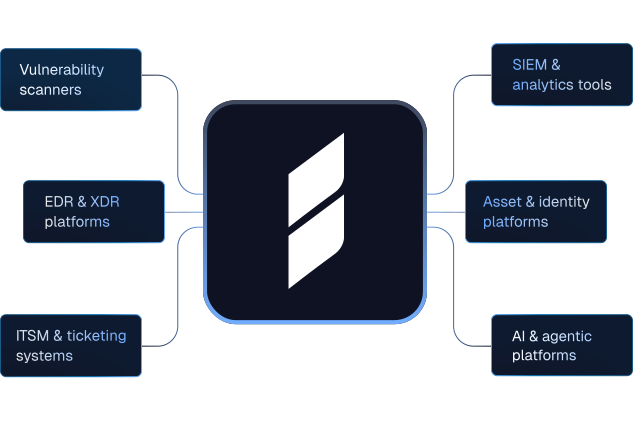
Integrate Spektion into your existing security workflow 

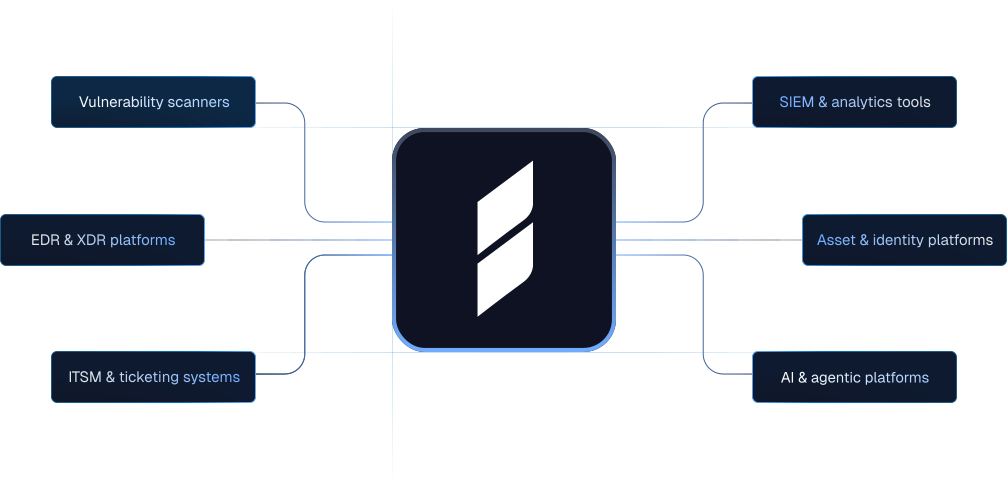
Mobilize faster by bringing runtime evidence into day-to-day security operations. Spektion works with:

Trusted by security leaders.

Learn More From Our Customers
FAQ

Frequently asked questions about the Spektion Platform.

If you're in a bake-off or building the business case, these are the answers you'll need.

How do I decide which CVEs are actually exploitable in my environment?

Exploitation requires three things: vulnerable code must execute, attacker input must reach it, and compensating controls must be absent. Scanners tell you what's installed. They can't tell you whether any of those conditions are met. Spektion observes software as it runs, with what privileges, and whether it is network-accessible, so your patch order reflects observed exploitability backed by runtime evidence, not a probability model. 50 to 80% of critical CVEs turn out not to require action.

What can I do when no patch is available?

For each exploitable condition, Spektion shows the preventive and detective controls your team can apply right away, from hardening settings to high-signal detections. Recommendations cover remediation, configuration changes, and compensating controls, so you can shrink what the software can reach if it is compromised (overprivileged processes, credentials on disk, unnecessary network exposure) while you wait for a patch. Feed the results to your SIEM, SOAR, or ticketing via API or MCP.

How do I see risk in internally built and AI-written applications that will never have a CVE?

Coding agents and internal teams are producing software with no application security review or gating. The Spektion sensor sees these applications as soon as they execute, even if only one user runs one on a single asset, and observes their runtime behavior: system calls, memory activity, privilege use, file access, and network connections. Risky patterns are mapped to MITRE ATT&CK techniques and CWE classifications, so exploitable conditions are reported with runtime evidence whether or not a CVE will ever exist.

Between scans, how would I know a software update introduced a new exploitable condition?

Software often changes behavior weeks or months after deployment through updates, configuration changes, or dependency modifications. Spektion observes runtime behavior continuously rather than on a scan schedule, monitors behavioral baselines, and alerts when an application begins performing risky or unexpected actions. When an update changes what executes, what privileges it runs with, or what it can reach, the runtime evidence changes with it, with no new scan cycle. First findings arrive within minutes of deploying the sensor.

Does Spektion replace my endpoint vulnerability management tool?

Spektion can replace an existing endpoint VM solution across every operating system, or sit alongside one to deliver the runtime evidence on exploitability that a CTEM program needs to work.