When the Zero-Day Drops, You Already Have the Answer.
Every security team scrambles to answer the same question when a zero-day hits: are we affected, and how badly? The teams who answer in minutes didn't react faster. The work was done before the clock started.

From CVE publication to active exploitation in the wild
Source: CISA KEV / Verizon DBIR
of CISA KEVs remain unpatched 30 days after disclosure
Source: CISA KEV Analysis
Increase in vulnerability exploitation as primary initial access vector
Source: Verizon DBIR 2024
Scanners run on schedules.
Attackers don't.
Sub-24hr exploit timelines have broken the traditional response pipeline. RBVM platforms wait for scanner data before enriching it. By the time you have a prioritized list, proof-of-concept exploits are already public.
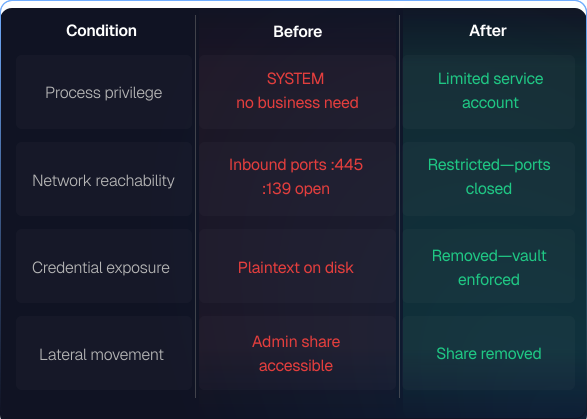
The deeper problem starts before disclosure. When a zero-day lands in an environment where processes run as SYSTEM without reason, credentials sit on disk, and services are network-exposed with no business justification, the damage ceiling is already set.


Your scanner wasn't running when it mattered.
Scheduled scans mean your data is stale before the question gets asked.
RBVM enrichment can't compress a multi-day pipeline.
Exploits don't give you the days that triage assumes.
The damage ceiling was set before disclosure.
Overprivileged processes, exposed credentials, unnecessary network access—these existed before the CVE was written.
"Are we affected?" still takes days to answer.
Every security team in the world is running the same scan, and attackers know the timeline.
Zero-day defense, before and after disclosure. Spektion covers both.
1. Before Disclosure
Shrink the conditions that make a zero-day catastrophic.
Spektion continuously observes your endpoints and surfaces the conditions that determine severity when something does land: overprivileged processes, credentials on disk, unnecessary network exposure, ungoverned AI workloads. You fix them before a CVE makes them urgent.
2. After Disclosure
Answer "are we affected?" in minutes, not days.
Because Spektion continuously observes runtime activity, the data you need is already there when a zero-day drops: which endpoints are running the affected software, with what privileges, and how reachable they are. The answer is a query against runtime evidence you already hold, with no new scan cycle.

Your exposure was set before the CVE existed. Spektion reduces it.
Undisclosed vulnerabilities: know what an attacker would find before they do.
Every endpoint in your environment carries conditions that determine how bad a compromise gets: what privilege level a process runs with, whether credentials are accessible on disk, and which ports are open with no business reason. Conditions like these exist independently of any CVE and are exploitable right now, whether or not a vulnerability is disclosed.
Spektion continuously observes software as it runs and surfaces undisclosed vulnerabilities as prioritized findings you can act on before a zero-day lands.
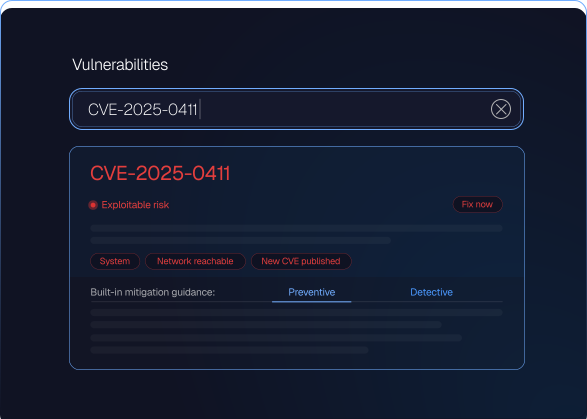
Instant impact assessment—from disclosure to affected endpoint list in seconds.
The moment disclosure hits, the data you need is already there. Query it. Which endpoints are running the affected software? Is it actually executing, or just installed? What privilege level? Is it network-accessible? How many endpoints were already remediated above?
Your scanner doesn't know yet. Your RBVM is waiting for scan data. Spektion has been watching—and the answer to "are we affected?" is available in seconds, not days.
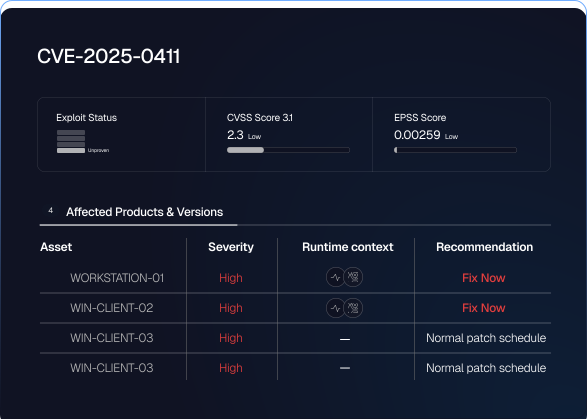
Ranked remediation order—a decision, not a dataset.
Other tools give you a list of every endpoint running the affected software. They all look equally urgent, which means you still have a triage problem. Spektion gives you a ranked order based on actual exploitability: execution state, privilege level, network reachability, and what prior remediation has already been applied. Endpoint 1 through N, with the evidence behind each ranking. No manual triage.
And because it comes from runtime evidence you already hold, not a new scan cycle, it arrives before your scanner knows to look.
"When the CLFS zero-day dropped, we knew within the hour which endpoints were running as SYSTEM, which processes had escalated privileges, and where an attacker could move laterally if they got in. Every other team spent two days figuring out if they were affected. We already knew our exposure, and we'd been reducing blast radius for months before it ever happened.
To identify exploitable endpoints after zero-day disclosure
A query against data that already exists, not a new scan cycle. No waiting for enrichment. No manual triage.
of critical CVEs turn out not to require action
Most endpoints that scanners flag as critical don't make the list. Runtime context tells you which ones actually matter.
To first runtime evidence after deployment
The data is in place before the next disclosure.
Deploy before the zero-day.
Everything else follows.
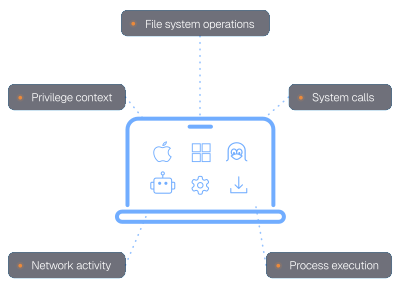
The Spektion sensor observes runtime behavior continuously. No sampling, no scheduling, no guessing. What's actually running, with what privileges, network-exposed, updated in real time across every endpoint.
Step 1
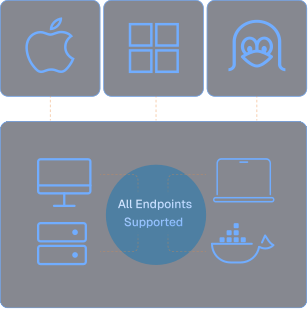
Deploy the lightweight sensor on Windows, Linux, and macOS. No reboot. Supports Intune, SCCM, Ansible, JAMF, Tanium, and CrowdStrike RTR. First runtime data within minutes.
Step 2
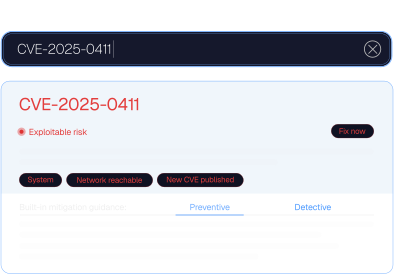
Spektion surfaces undisclosed vulnerabilities continuously. Your team remediates. The exposure footprint shrinks before any zero-day lands.
Step 3
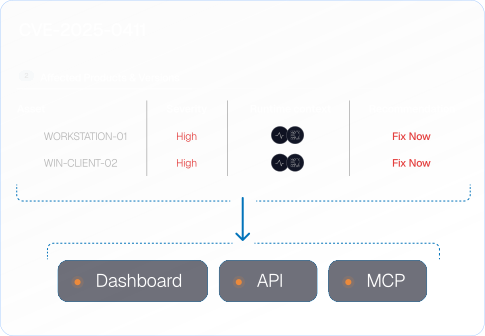
The data is already there. Query it. Affected endpoints ranked by exploitability, available in seconds.
Step 4
Ordered by exploitability. Full evidence log per finding. Feed directly to SIEM, SOAR, or ticketing via API or MCP integration.
Frequently asked questions about Spektion’s zero-day defense.
If you're in a bake-off or building the business case, these are the answers you'll need.
Spektion observes runtime behavior continuously; it doesn't wait for a scan trigger. When a zero-day is disclosed, query Spektion to find exactly which endpoints are running the affected software, whether it's actively executing, what privileges it has, and how exposed it is. The runtime evidence Spektion already holds has the answer, with no new collection cycle needed.
An undisclosed vulnerability is an exploitable condition that exists before any CVE is published for it, such as credentials stored on disk, processes running with unnecessary SYSTEM-level privileges, network ports open with no business justification, browser extensions with access to session tokens, and lateral movement paths left accessible. Spektion surfaces them continuously so you can proactively remediate before a CVE forces the issue. This is what a Red Team does when they assess an environment. Spektion automates it at scale.
Already deployed? Seconds because you're querying data that already exists. Starting fresh? First runtime data is available within minutes of deployment.
Two things. First, behavioral signals in Spektion's runtime evidence can indicate exploitation patterns even before a CVE is published. Second, hardening before disclosure limits what an attacker can reach through vulnerabilities that haven't been disclosed yet. If credentials aren't on disk and processes aren't running as SYSTEM unnecessarily, an undisclosed zero-day has less to work with.
The same Spektion sensor that surfaces CVE exploitability and undisclosed vulnerabilities also covers AI agents, MCP servers, coding assistants, and AI-generated executables running on your endpoints. All are included in both pre-disclosure hardening and post-disclosure impact assessment. One sensor, one complete picture.
Threat intel tells you what's being exploited globally. That's useful context, but it can't tell you what's exploitable in your environment. Runtime observation can.
You'll see your first runtime data within minutes of deployment. When a zero-day occurs, you'll see affected endpoints, ranked by exploitability, in real time.
When the board asks whether you're affected and what your exposure is, you'll have a precise, defensible answer. Spektion's reporting capabilities let you combine endpoint, software, vulnerability, and runtime risk data into a single exportable view—the evidence you need, ready to present. Not patch counts. Exploitability reduction.
A typical trial/POV runs three weeks across 100-500 endpoints.
Week 1: Deploy, access first runtime data within minutes, begin seeing undisclosed vulnerabilities, CVE exposure, and runtime risk, all together, in your environment.
Week 2: Review pre-exploitation findings together and walk through exposure reduction opportunities.
Week 3: If a zero-day drops during the trial, you'll see exactly which endpoints are affected, ranked by exploitability, in real time. Compare the findings against your current stack. The difference will be clear.