Patch Management vs Vulnerability Management: Why the Difference Matters
Vulnerability management is the broader process of identifying, prioritizing, and remediating security vulnerabilities across your environment. Patch management is one remediation method within it: applying vendor updates to fix known software flaws. Vulnerability management decides what to fix and why. Patch management is one way you do the fixing.
Team Spektion
Spektion Research
September 3, 2025
·
— min read
On this page
Last updated October 2026.
In many organizations, “vulnerability management” has become a catch-all term for finding and fixing software flaws. In practice, what most teams do is patch management: rolling out vendor patches and software updates on a fixed schedule, usually driven by IT operations.
While patching is essential, it is not the same as vulnerability management. Treating them as interchangeable leaves critical exposures unaddressed, especially when attackers move faster than patch cycles.
Patch Management: Operational, Not Risk-Driven
Patch management is an IT-driven process focused on keeping systems current with vendor fixes by acquiring, testing, and installing updates for software and systems. It’s all about staying up-to-date.
In practice, patch management typically looks like this:
Primary goal: Maintain system stability and security through vendor updates
Ownership: IT operations, often bound by maintenance windows (monthly or quarterly)
Trigger: New vendor patches or updates
Patch management runs on a schedule, and the schedule does not know which exposures matter. Teams plan around the capacity to patch rather than around the risks that matter to the business. For example, suppose a new RCE is disclosed the day after a scheduled patch cycle; patching on a set schedule means it sits unaddressed until the next maintenance window, barring an emergency change, leaving systems exposed despite “being up to date.” There is only so much engineering capacity and political capital available to field such emergency changes.
Limitations of patch management include:
High-risk vulnerabilities can go unpatched for weeks if they fall outside the patch cycle
Effort may be wasted patching low-impact issues while dangerous exposures remain
Undisclosed vulnerabilities aren’t addressed at all, since they lack vendor fixes
Patch management is essential but incomplete. It keeps systems current, but by itself it doesn’t provide a risk-based view of which exposures matter most, and that’s where vulnerability management steps in.
Vulnerability Management: Risk-Based and Continuous
Vulnerability management is broader and more strategic than patch management. It continuously identifies and reduces the actual risk of exploitation, which is a different job from managing the capacity available to apply patches.
The lifecycle typically includes:
Asset Discovery: Knowing exactly what’s running in your environment
Vulnerability Identification: Detecting known CVEs, misconfigurations, and exploitable conditions
Risk Prioritization: Ranking issues based on severity and likelihood of exploitation
Remediation or Mitigation: Applying patches, configuration changes, or compensating controls
Validation: Confirming the risk has been reduced or eliminated
Analyst frameworks like Gartner’s Continuous Threat Exposure Management (CTEM) model emphasize this type of continuous cycle as the foundation of modern vulnerability management programs. If you have a CTEM program or are planning on implementing one, check out this article: CTEM Program Visibility Gaps and How to Close Them at Runtime.
Vulnerability management does not stop at “is there a patch?” It asks whether this vulnerability is exploitable here and what the fastest way to reduce the risk is.
Patch Management vs Vulnerability Management at a Glance
Here’s how the two approaches differ side by side.
Patch Management
Vulnerability Management
Goal
Apply vendor updates
Reduce exploitable risk
Owner
IT operations
Security teams (with IT collaboration)
Trigger
Patch release
Continuous risk monitoring
Scope
Known flaws with patches
Known CVEs, undisclosed vulnerabilities, misconfigurations
Cadence
Monthly/quarterly windows
Continuous
Success Metric
% patches applied
Reduced attack surface, validated risk reduction
How Patch Management and Vulnerability Management Work Together
Vulnerability management is the decision layer. Patch management is the execution arm. A working vulnerability and patch management program keeps the two connected without letting either one absorb the other.
Security owns the decision: which vulnerabilities require action, on which hosts, and by when. Patching, configuration changes, and compensating controls are the remediation options, and patching is the one with a vendor fix attached. IT operations owns the execution: testing the patch, scheduling the change, and confirming it landed. In most enterprises the teams applying patches do not report to security, so the decision layer has to hand them something they can verify on the host itself. A severity score invites a debate about whose model is right. Runtime evidence that the vulnerable component is executing, at what privilege and with what network exposure, settles it.
Federal policy now draws the same line. CISA’s Binding Operational Directive 26-04, issued June 10, 2026, supersedes BOD 19-02 and BOD 22-01 and sets remediation timelines from four questions about the vulnerability in context: whether the asset is publicly exposed, whether the vulnerability is in the Known Exploited Vulnerabilities catalog, whether an adversary can automate the exploit, and whether exploitation gives partial or total control of the asset (CISA BOD 26-04). The directive it replaced, BOD 19-02, set its deadlines by CVSS severity alone: 15 days for critical, 30 for high. The KEV catalog that anchors the first question held 1,748 entries on October 16, 2026 (CISA KEV catalog), a short list next to what a scanner reports. Exploitation concentrates in a small set of vulnerabilities, and the deadline follows the evidence of it.
In practice the handoff has three parts. Security publishes a ranked list with the evidence behind each entry. IT works the list in order and records the patches it decided to delay or not apply, with the reason. Both teams review what changed at runtime after the maintenance window, because a patch that did not land, or a service that restarted into the same exposed state, shows up there first.
What Happens When No Patch Exists?
The limits of patching become clear when the risk isn’t tied to a vendor fix. Some of the most dangerous exposures, from zero-days to configuration drift to exploitable conditions in internally built and AI-written applications, have no patch available, and the organization stays exposed until it takes other steps.
True vulnerability management fills that gap with:
Preventative controls (architectural or configuration changes to prevent exploitation)
Runtime monitoring and behavior detection (e.g., custom EDR or SIEM rules to shift detection capabilities left)
Residual risk analysis to understand the risk the organization is carrying until full remediation
None of these exposures has a CVE to scan for, so the first job is finding them on the hosts where they exist. That is the work of detecting risk beyond CVEs with runtime evidence.
Where Spektion Fits
The gap between patch management and vulnerability management is where most organizations struggle. Patching keeps systems current. It does not answer which risks matter on which hosts right now, and that is the question Spektion answers.
With The Spektion Platform, security and IT teams get runtime evidence on installed software: what is executing, at what privilege, with what network exposure, and what it can reach if it is compromised. Across Spektion deployments, ~70% of critical CVEs exist in non-executing software. 50 to 80% of critical CVEs turn out not to require action, and the ones that do carry the runtime evidence showing why they matter. Five things change:
Uncover hidden software: Identify unmanaged, shadow, and legacy applications that traditional asset systems often miss, eliminating blind spots that attackers often target first.
Find undisclosed vulnerabilities: Memory injection, privilege escalation paths, exposed secrets on disk, and insecure network behavior, found at runtime before a CVE is published.
Prioritize by exploitability: Runtime vulnerability prioritization combines the CVE catalog, exploit intelligence, and runtime evidence so teams know which CVEs require action on which hosts.
Act when no patch exists: Apply OS configurations that block exploitation and detective content for the SIEM, so exposure drops without waiting on a vendor.
Bridge IT and Security: Deliver the prioritized list and its evidence directly to IT operations so patching effort follows observed exploitability rather than release notes.
The result is a shorter list that IT can work in order, with the evidence for each entry attached.
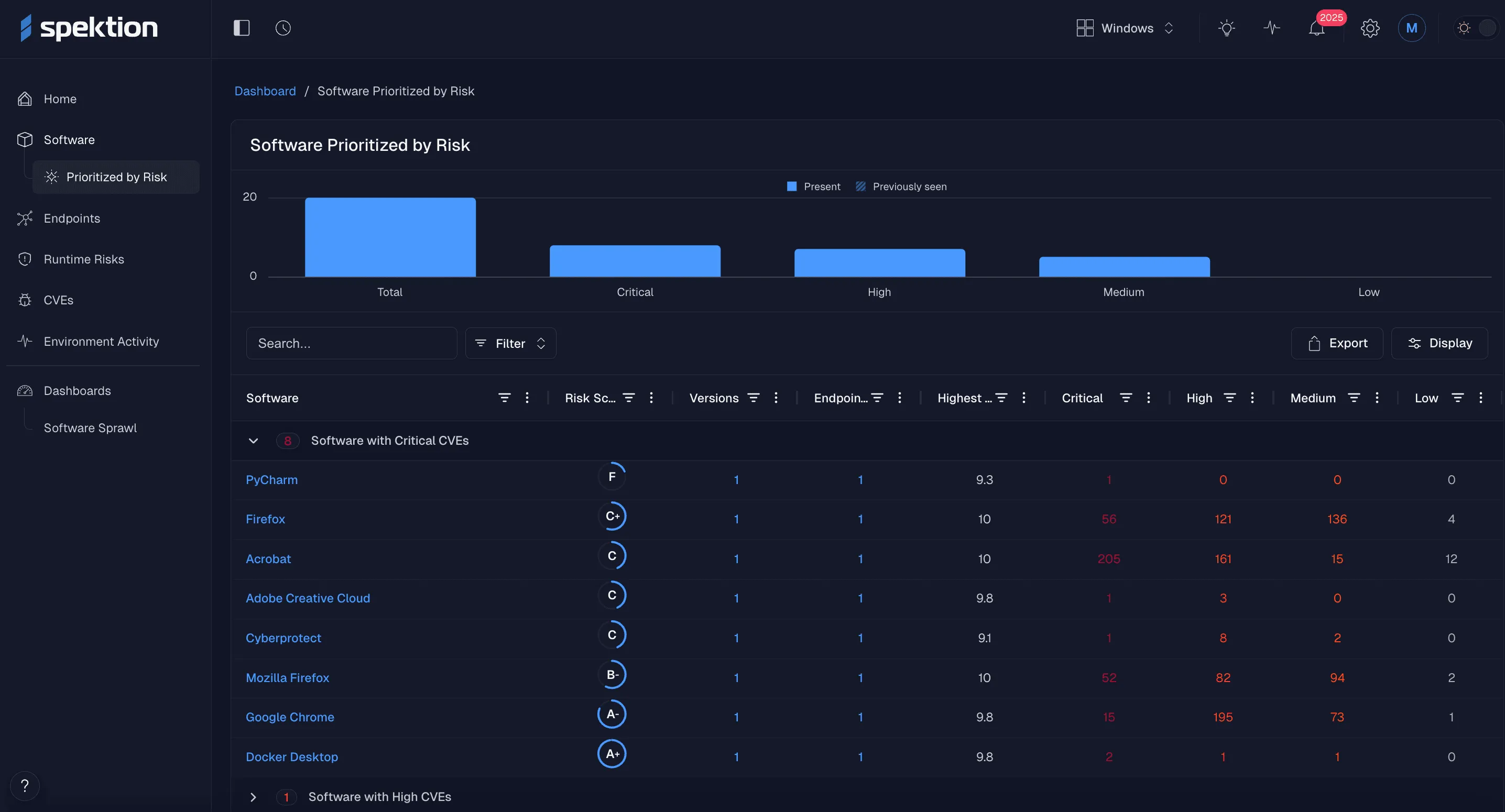
Example Spektion dashboard showing prioritized risks ranked by criticality (exploitability and runtime behavior)
Frequently Asked Questions
Is patch management part of vulnerability management?
Yes. Patching is one remediation step inside the broader vulnerability management lifecycle.
What comes first, patch management or vulnerability management?
Vulnerability management comes first. You identify and prioritize vulnerabilities before deciding what to patch.
Can you do vulnerability management without patching?
Yes. Mitigations, compensating controls, configuration changes, or removing unused software all reduce risk, and they are the only options when no patch exists.
Why isn’t patching everything enough?
You cannot patch zero-days, misconfigurations, exposed secrets, or custom code. Patching by CVSS severity also spends effort on flaws that are not exploitable in your environment.
What’s the difference between a vulnerability scan and a patch?
A scan identifies vulnerabilities. A patch is one fix you apply to some of them.
Why This Matters
For security leaders, the difference between patch management and vulnerability management decides whether the program reduces exploitable risk or reports patch velocity. Verizon’s 2026 Data Breach Investigations Report found that 31% of breaches now start with software vulnerabilities, ahead of stolen passwords as the top way attackers get in (Verizon 2026 DBIR). Patch management is how IT teams address the vulnerabilities security prioritized. Vulnerability management is how security teams rank vulnerabilities by risk and handle the residual risk for what cannot be patched.
Many security teams describe a patching process as vulnerability management. Without runtime evidence, security cannot tell IT which vulnerabilities require action, and IT cannot order patches by exploitability.
Organizations that move from patch cycles to risk-driven vulnerability management spend fewer cycles on CVEs that do not require action, remediate what matters sooner, and put controls in place on the attacker’s timeline rather than the vendor’s.
Spektion prioritizes vulnerabilities on evidence from your own environment, alongside the CVE catalog and exploit intelligence, rather than on external scores alone.
IT and security work from the same prioritized list, so each patch, mitigation, or removal lands where it reduces exposure the most.
To see how runtime evidence changes vulnerability management in practice, read the whitepaper:
Download the whitepaper to explore how runtime intelligence transforms vulnerability management
See what's exploitable in your environment, whether there's a CVE for it or not.
Many exploitable vulnerabilities never get a CVE. Book a demo to see how Spektion finds what's actually exploitable across your endpoints.