Spektion Discovers a Remotely Accessible Named Pipe in Adobe Genuine Service
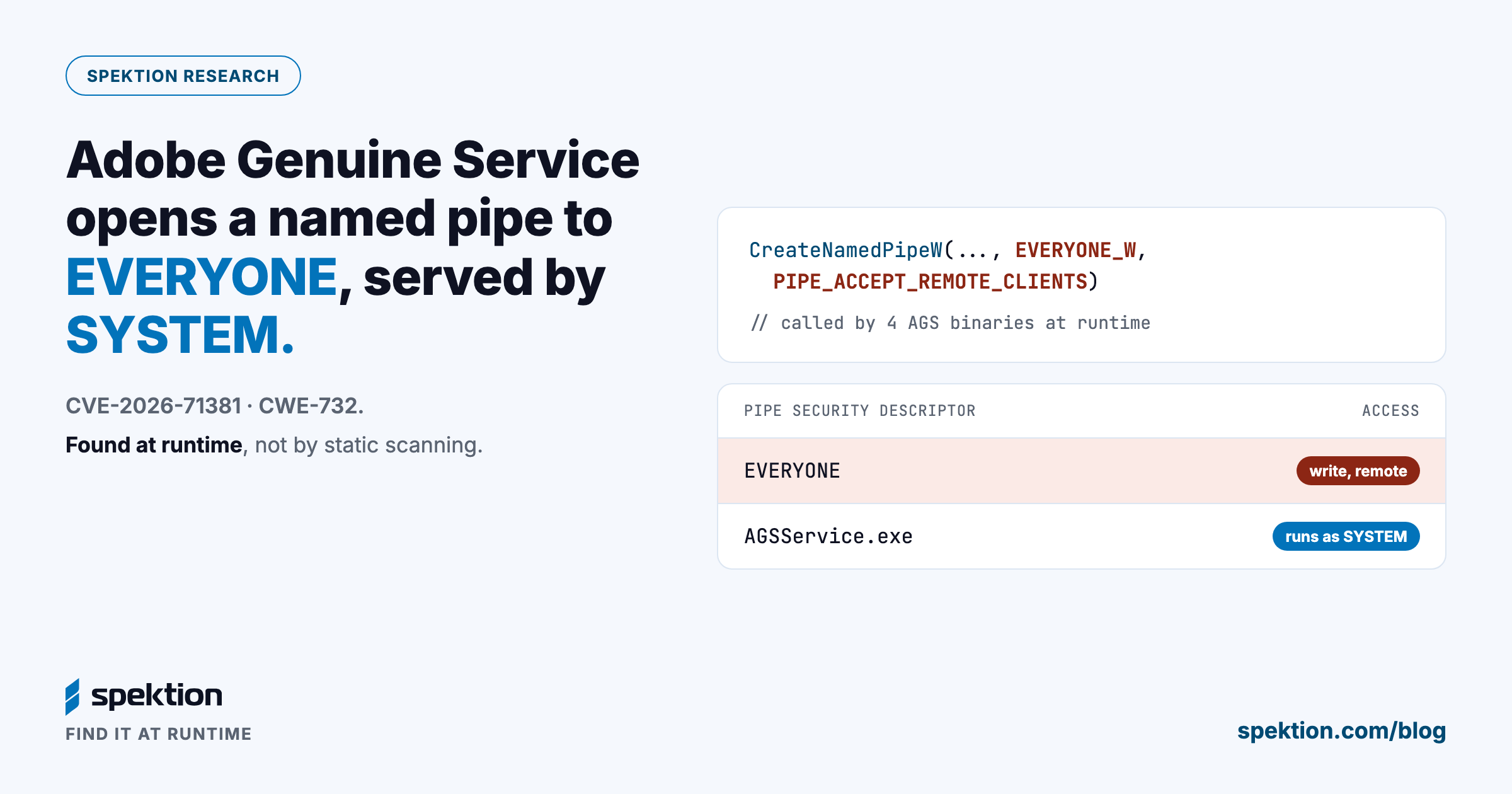
Adobe Genuine Service creates a named pipe writable by EVERYONE, served by a process running as SYSTEM. Adobe fixed it in July, published no advisory, and scored it a 4.0.
David Westcott
Head of Threat Research
August 20, 2026
·
— min read
On this page
Spektion Research discovered and disclosed a remotely accessible named pipe vulnerability in Adobe Genuine Service, caught at runtime, where static tools don't look.
This post is part of an ongoing series from Spektion Research documenting vulnerabilities discovered through Spektion's runtime analysis. Read on for the full details on CVE-2026-71381.
Key Takeaways
CVE-2026-71381: Adobe Genuine Service creates named pipes with an ACL granting write access to EVERYONE and a pipe mode that accepts remote clients. The pipe is served by AGSService.exe, which runs as SYSTEM. That makes this a lateral movement and privilege escalation primitive rather than the local-only issue the published CVSS vector implies.
The vulnerability was discovered through Spektion's runtime evidence, not static scanning, because the flaw only manifests when the software executes.
Spektion telemetry shows the service running in 60% of monitored customer tenants. It installs opt-out with Acrobat Reader and Creative Cloud, so most organizations are running it without having chosen to.
Writing to the pipe requires an authenticated SMB session to the host (TCP 445). Anonymous access is possible only where null sessions are enabled and the pipe is listed in NullSessionPipes.
Adobe scored this 4.0 with Attack Vector: Local. Spektion assesses it at 8.1, with the attack vector scored as Network, because the pipe is created to accept remote clients, and both confidentiality and integrity impact scored as High.
All versions prior to 10.1.0.33 are vulnerable, and current installers still bundle a vulnerable 8.x build. The fix lands only when a scheduled task fires on a 6-hour interval, and in testing with standalone Acrobat Reader installs it did not consistently run.
Background
The Adobe Genuine Software Integrity Service (Genuine Service, or AGS) is a "service that periodically verifies whether Adobe apps on your machine are genuine and notifies you if they are not," according to Adobe. In other words, AGS is the anti-piracy service bundled with Adobe software installations, checking to ensure the installed applications are legitimate.
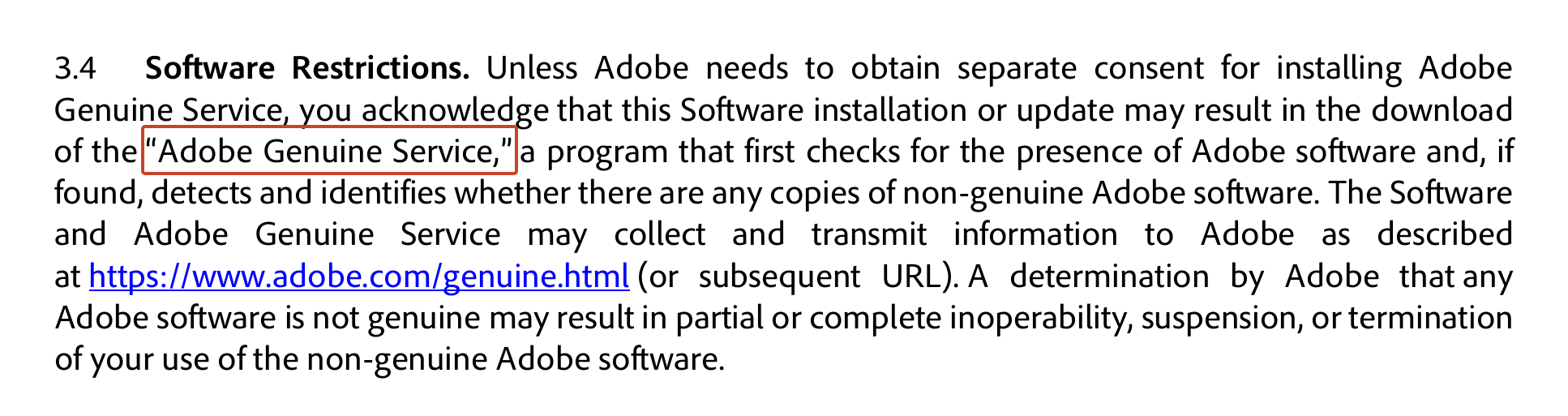
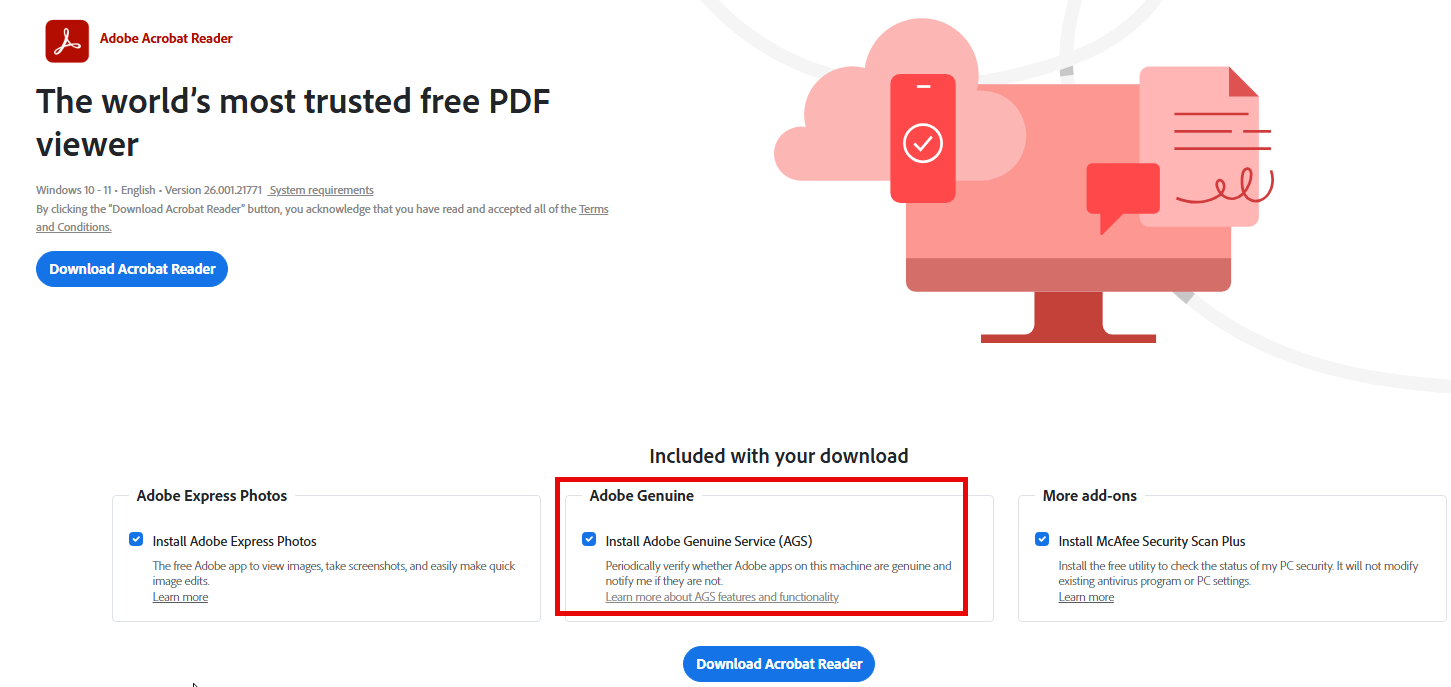
Because of where and how the application is installed, many Adobe customers likely don't know they're running this service unless they read the EULA, or noticed it before clicking the download button on Adobe's site.
Figure 1: Adobe Reader's EULA discloses Adobe Genuine Service in section 3.4, Software Restrictions.
Any current Adobe user is more than likely running this service today, on their own computer or, more importantly, across every machine in their organization.
Discovery
This vulnerability was identified using the Spektion Platform on an affected endpoint. Spektion monitors software behavior during execution by observing system calls, process creation events, and API activity in real time, rather than scanning files at rest.
When Adobe Genuine Service launched, Spektion flagged that four of its binaries call the named pipe creation API with a security descriptor granting write access to Everyone, with remote clients enabled. Spektion's research team reproduced the pipe creation on a clean install and confirmed which binaries create it. Spektion did not attempt a write from a second host. Because the pipe is created with a mode that accepts remote clients, it is reachable by anyone with access to the host, which follows from the pipe descriptor and Microsoft's documented behavior for that mode.
Root Cause Analysis
When an Adobe product is installed, it comes bundled with the Adobe Genuine Service tool. At least four of the included files call CreateNamedPipeW with an EVERYONE_W ACL and a pipe mode of PIPE_ACCEPT_REMOTE_CLIENTS.
Description: Adobe Genuine Software Integrity Service on Windows is affected by an Incorrect Authorization vulnerability that could result in a Security feature bypass. An attacker could leverage this vulnerability to bypass security measures and gain unauthorized limited write access. Exploitation of this issue does not require user interaction, but requires the attacker to access the target desktop system locally (e.g., keyboard, console), or remotely (e.g., SMB).
Spektion's assessment of this CVE description, CVSS score, attack vector, and CWE:
The CVE description above doesn't accurately represent the risk or give defenders enough detail to understand impact or potential attack surface. A better description would name who is affected (everyone running Adobe products), the scope (a named pipe accessible and writable by anyone with access), and what an attacker can achieve with that level of access.
In Spektion's assessment, the CVSS score should be 7 or higher. Conversations with Adobe PSIRT suggested a fundamental misunderstanding of the vulnerability.
Given the observed pipe mode PIPE_ACCEPT_REMOTE_CLIENTS, the Attack Vector should be Network rather than Local, per Microsoft's own definition of the pipe mode: "Connections from remote clients can be accepted and checked against the security descriptor for the pipe."
Based on the behavior observed during execution, the CWE should have been CWE-732, Incorrect Permission Assignment for Critical Resource. Adobe's CWE-863, Incorrect Authorization, describes a flawed access decision. What Spektion observed is a permission grant that was wrong when it was written: an ACL giving write access to EVERYONE on a pipe served by a SYSTEM process. CWE-306, Missing Authentication for Critical Function, would apply to the null-sessions case, but that case is conditional on host configuration and is not the default.
Of the 1,270 vulnerabilities assigned CWE-306 in NVD over the preceding 12 months (pulled August 10, 2026), the leading exact scores were 9.8 (208 CVEs), 9.3 (137 CVEs), and 8.8 (134 CVEs). That makes Spektion's "7 or higher" estimate potentially still low, given how this named pipe is used in Adobe's integrity service.
CWE: CWE-732, Incorrect Permission Assignment for Critical Resource
Basis for this scoring:
Attack Vector is Network, not Local. The pipe is created with PIPE_ACCEPT_REMOTE_CLIENTS, so under Microsoft's documented behavior for that mode it is reachable from another host. Spektion confirmed the pipe and its security descriptor on a clean install; it did not attempt a cross-host write.
Privileges Required is Low. Writing to the pipe requires an authenticated SMB session to the host, though anonymous access is possible where null sessions are enabled.
Confidentiality and Integrity impact are High. The pipe is both readable and writable by EVERYONE, and it is served by AGSService.exe running as SYSTEM.
The average base score for those 1,270 CWE-306 CVEs (NVD, pulled August 10, 2026) is 8.24, in line with how this class of vulnerability is normally scored.
On the Attack Vector specifically: under the CVSS v3.1 specification, Local means the vulnerable component "is not bound to the network stack" and the attacker's path runs through read, write, or execute capabilities on the target, whether at the console or over a remote shell such as SSH. Adobe's description reuses that language, with SMB as the remote example. In this case, SMB is the transport the named pipe itself listens on once it is created with PIPE_ACCEPT_REMOTE_CLIENTS. An attacker never needs a shell on the target; the pipe server is reachable "at the protocol level one or more network hops away," which is the specification's definition of Network. A named pipe served by a SYSTEM process, reachable from another host, is a lateral movement primitive, and a 4.0 does not tell a defender that.
VulnCheck, the CNA that managed this disclosure, published its own advisory for CVE-2026-71381. It rates the vulnerability high severity with a CVSS score of 8.1 and CWE-732, both matching Spektion's assessment and both differing from Adobe's published record.
Affected Versions
All versions prior to 10.1.0.33.
Even the most up-to-date installers for Creative Cloud and other Adobe applications that bundle this service still ship the old 8.x version. The updated version isn't installed until the Windows Task runs for the first time, a 6-hour delay.
The update mechanism also doesn't appear to work consistently across Adobe applications. In testing, installing Adobe Acrobat Reader as a stand-alone application, instead of through Creative Cloud, did not consistently receive the update.
Remediation
The CVE record's Solutions field states: "No action is required of Adobe app users to received the fixed version of AGS; it receives automatic updates." (The typo is Adobe's.) That was not Spektion's experience. Given the risks associated with this vulnerability type, Spektion recommends a remediation plan that does not depend on Adobe's automatic update mechanism.
If your environment supports initiating scheduled task mechanisms organization-wide:
Update to the most recent version of the Genuine Service by manually running the Adobe-Genuine-Software-Integrity-Scheduler-1.0 task from within Windows Task Scheduler.
In Spektion's testing, this yielded inconsistent results. Validate the current version of the application (using file metadata) before marking the asset as remediated.
If an immediate update isn't possible or realistic in your environment, use available EDR or other on-host methods to audit interaction with the named pipes this application creates for anything suspicious.
Can AGS be removed? Spektion did not test removal. Given the service's role in license validation, and given that Adobe's EULA section 3.4 makes the genuineness check a condition of the license, disabling or removing it can affect installed or purchased Adobe software. Treat removal as a licensing decision, not a routine hardening step.
Detection
Any presence of this tool prior to version 10.1.0.33 is vulnerable and should be remediated. These files are located within the following directories:
Use a tool like pipelist to determine which named pipes exist on a system, along with their ACLs and pipe mode. A device is vulnerable if it has one of the named pipes below with an ACL of EVERYONE_W and a pipe mode of PIPE_ACCEPT_REMOTE_CLIENTS:
adobe_gc_pipe_[0-9]{4,5}_[0-9]{4,5}
gc_pipe_[a-z]{5}\s[0-9]
Example Spektion logs
The following is example Spektion telemetry observed in production tenants:
Present telemetry shows this software running in 60% of Spektion's monitored customer tenants as of August 2026. A tenant counts as affected when AGS binaries appear in either install path and at least one runtime detection has fired on them.
Spektion detections associated with the product (11)
In addition to the named pipe vulnerability, Spektion also observed the following exploitable runtime behaviors related to this software:
Application created file in public user profile. Example path: C:\Users\Public\Documents\AdobeGC\*
Application creates a remotely accessible named pipe. Patterns: adobe_gc_pipe_[0-9]{4,5}_[0-9]{4,5}, gc_pipe_[a-z]{5}\s[0-9]
Application created file with insecure permissions. Example paths: C:\Windows\Temp\AdobeGCLogs (acl: EVERYONE_WRITE), C:\Users\Public\Documents\AdobeGCData (acl: EVERYONE_WRITE)
Application created service with unquoted path.{'serviceName': 'Adobe Genuine Software Monitor Service', 'servicePath': 'C:\\Program Files (x86)\\Common Files\\Adobe\\AdobeGCClient\\AGMService.exe', 'serviceShortName': 'AGMService'}
Application created a remotely accessible named pipe that is writable without authentication. Patterns: adobe_gc_pipe_[0-9]{4,5}_[0-9]{4,5}, gc_pipe_[a-z]{5}\s[0-9]
Application used deprecated function (CryptEncrypt).C:\Program Files (x86)\Common Files\Adobe\AdobeGCClient\AdobeGCClient.exe, C:\Program Files (x86)\Common Files\Adobe\AdobeGCClient\AGSService.exe
Application called CreateProcess with unquoted path.{'commandLine': 'C:\\Program Files (x86)\\Common Files\\Adobe\\AdobeGCClient\\AGSService.exe \\\\.\\pipe\\gc_pipe_redacted', 'currentDirectory': 'C:\\Program Files (x86)\\Common Files\\Adobe\\AdobeGCClient'}
Application allocated executable memory pages in the current process.
Application created Windows registry autorun entry.{'fullRegPath': '\\REGISTRY\\MACHINE\\SOFTWARE\\Microsoft\\Windows\\CurrentVersion\\Run', 'lpData': '"C:\\Program Files (x86)\\Common Files\\Adobe\\AdobeGCClient\\AGCInvokerUtility.exe"', 'lpValueName': 'AdobeGCInvoker-1.0'}
Application attempted to determine if a debugger was present (IsDebuggerPresent).C:\Program Files (x86)\Common Files\Adobe\AdobeGCClient\: AdobeGCClient.exe, AGMService.exe, AGCInvokerUtility.exe, AGSService.exe
Application initiated unencrypted HTTP traffic.C:\Program Files (x86)\Common Files\Adobe\AdobeGCClient\AGSService.exe, {'flags': '~WINHTTP_FLAG_SECURE', 'server': 'agsupdate.adobe.com', 'url': 'win32/AGC_5_0_0_950_win32_cef.zip', 'port': '80'}. Analyst note: the very old version number (5.0.0.950, win32) indicates this has been remediated in later versions and doesn't impact current implementations of the service.
Researcher Credit
This vulnerability was discovered by the Spektion Research Team while running Spektion and is disclosed in accordance with Spektion's coordinated vulnerability disclosure policy. Spektion thanks its partners at VulnCheck for managing the disclosure process as its CNA.
Disclosure Timeline
April 9, 2026: Initial outreach to Adobe PSIRT.
April 12, 2026: Adobe requested additional technical details.
April 16, 2026: VulnCheck performed a 7-day check-in.
April 27, 2026: Adobe acknowledged the report and began product team testing.
April 30, 2026: Additional technical information regarding the AGSService.exe named pipe was shared with Adobe.
May 13, 2026: Followed up with Adobe for a status update.
May 27, 2026: Adobe confirmed it was still working with the engineering team.
May 28, 2026: Adobe confirmed the issue was validated and targeted an early July release for the fix.
August 5, 2026: When VulnCheck asked for an update, Adobe notified VulnCheck the issue was fixed in the July release, with no advance notice. Adobe did not disclose what was fixed or how, and did not publish any details for its customers or as part of the disclosure. Everything in this post is the result of Spektion manually determining how the service works to confirm the issue was remediated.
August 6, 2026: VulnCheck requested a CVE ID, as the 120-day disclosure deadline was August 7, 2026.
August 7, 2026: Adobe published CVE-2026-71381.
August 11, 2026: VulnCheck followed up with Adobe about potential errors in the published CVE record.
August 14, 2026: Spektion validated fixed-version information and the release date.
August 19, 2026: VulnCheck published its advisory for CVE-2026-71381, scoring it 8.1 with CWE-732.
Closing Thoughts
Adobe Genuine Service is the primary integrity and licensing platform Adobe uses to ensure its customers are running legitimate, legally licensed software. Because of where it's installed (Common Files) and the inconsistencies between the application name written to the registry and the file metadata associated with the binaries involved, some traditional VTM solutions might miss this application's presence altogether.
As Spektion continues to work with vendors on responsible disclosure, it is consistently surprised by how often those communications reveal a lack of understanding of how the vendor's own software works, and by how broken the CVE process is overall. Throughout this escalation and CVE issuance, Spektion reached a point where it stopped asking Adobe PSIRT for clarification and relied on its own analysis to reach informed conclusions. Some key items that were lacking or incomplete in those conversations:
How does this process work in the context of Adobe Creative Cloud versus standalone installers?
Why does the most recent version of the application still ship with insecure code?
How would Adobe customers know the severity of this vulnerability and the scale of its impact, given that Adobe isn't publishing a security advisory and its CVSS scoring and CWE are incorrect?
All of this reinforces Spektion's view that CVEs, while a meaningful data point, are increasingly unreliable and often published too late.
This finding is a reminder that runtime behavior, what software actually does when it runs, is a fundamentally different attack surface than static analysis or file-based scanning can see. Keeping software updated remains the most reliable defense, and runtime visibility remains the most reliable way to find what static tools miss.
Indicators
Named Pipe(s)
adobe_gc_pipe_[0-9]{4,5}_[0-9]{4,5}
gc_pipe_[a-z]{5}\s[0-9]
Tasks
Task name:Adobe-Genuine-Software-Integrity-Scheduler-1.0. Action:C:\Program Files (x86)\Common Files\Adobe\AdobeGCClient\AGSService.exe. Run as: SYSTEM. Trigger: every 6 hours, indefinitely, highest privileges.
Task name:AdobeGCInvokerLogon. Action:C:\Program Files (x86)\Common Files\Adobe\AdobeGCClient\agcinvokerutility.exe. Run as: Everyone. Trigger: at log on of any user.